Short answer: Open a fresh or logged-out chat. Ask ChatGPT, Gemini, Claude and Google AI Overviews 5 to 10 questions a real buyer would type, without your business name. Record who is named and which sources are cited. Count the questions where you appear out of the total, then repeat monthly.
Picture a small business owner on an ordinary Tuesday. A prospect calls to book, and says almost in passing, “ChatGPT suggested someone else, but I thought I would try you first.” The owner laughs it off, then stops. How many people got that suggestion and never called at all?
That is the real cost. Nobody sends a complaint when an AI skips you. The lead simply goes elsewhere, and you never see it.
That evening the owner stops guessing. Instead of typing the business name, they type the questions a buyer would ask, one at a time, in a fresh chat. They write down every business that gets named and every site that gets cited. It takes an hour.
By the end they have a short list of questions they lose and the pages that win them. The next morning they know what to write first, and they are no longer worried about something they cannot see. That’s a composite, not a real client.
How do I check if ChatGPT recommends my business?
Do not type your own name into the box. That only tests whether ChatGPT knows you exist. Buyers ask for a solution, so test that instead. Here is the manual method I would use.
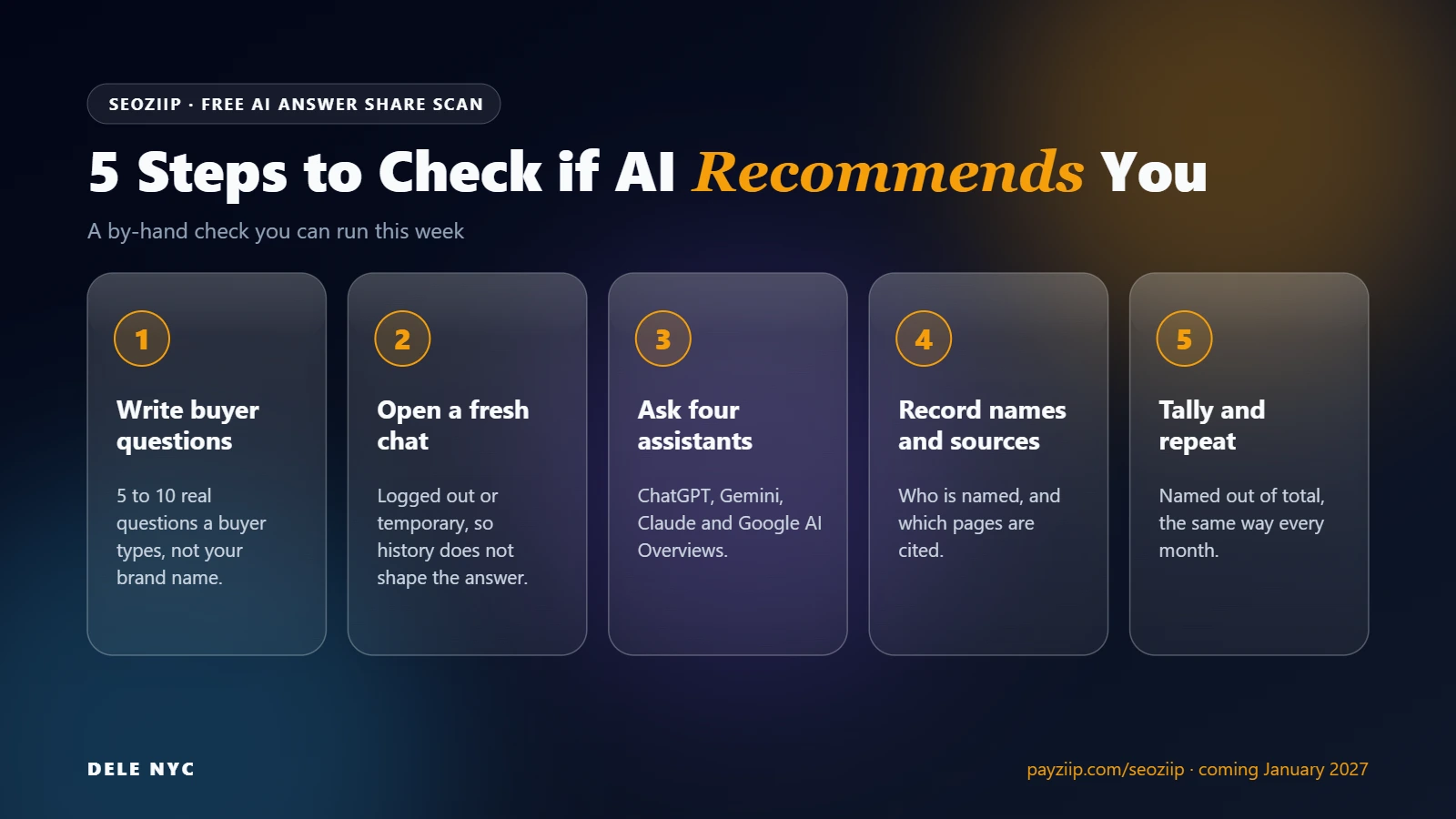
- Write 5 to 10 real buyer questions. Use the words customers use, such as “best accountant for a small bakery in Austin” or “how much does a roof repair cost.”
- Open a fresh session. Use a logged-out window or a temporary chat so your past conversations do not shape the answer.
- Ask each question in four places: ChatGPT, Gemini, Claude and Google AI Overviews.
- Record the result. Note the date, the tool, whether you were named, which competitors were named, and which sources were cited.
- Repeat monthly. Same questions, same tools, same scoring.
When ChatGPT uses search, it shows citations. OpenAI’s help page on ChatGPT search says responses that use search contain inline citations, and a Sources button lists every cited source. Those sources are your best clue about what the assistant trusts.
What a simple hand tally looks like
You do not need software to score this. Make a grid with questions down the side and tools across the top. Put a 1 where you were named and a 0 where you were not.
Then count. If you test 10 questions on 4 tools, you have 40 cells. Your tally is the number of 1s out of 40. As a made-up example, 6 out of 40 means you appear in 15 percent of checks.
Two refinements help. First, run each question twice, because answers vary. Second, add a column for “named but wrong,” since an inaccurate mention is a different problem from a missing one.
This is a do-it-yourself tally, nothing more. Its value is that it stays the same each month, so you can see movement.
What questions should I ask ChatGPT, Gemini and Claude?
Several guides I read tell you to avoid your brand name, and I agree. Some give example prompts, but few tell you how to choose them. Here is a simple way.
Pull questions from places buyers already speak
- Phone calls and emails you get every week.
- Reviews that mention why someone chose you or a rival.
- The questions your sales conversations always start with.
- Your Google Search Console queries, if you have it connected.
Cover four kinds of question
- Problem: “my basement floods after rain, who fixes this?”
- Comparison: “A versus B for a five-person team.”
- Cost: “how much does this usually cost?”
- Local or niche: “best option for [your type of customer] in [your city].”
This is the same exercise the owner did in the opening story. The questions that hurt are rarely the ones you would guess.
Why doesn’t ChatGPT mention my business?
Usually it is one of a few plain reasons, and most are fixable.
- No page answers the question. If your site never states the answer clearly, there is nothing to cite.
- Your details disagree across the web. Different names, addresses or services on different sites weaken trust.
- Other sites speak for you. Assistants often cite directories, reviews and articles instead of your own pages.
- You are blocked. Check that your site is not accidentally keeping crawlers out.
One gap I noticed across the guides I read: they tell you to look, but not how to separate noise from a real change. Answers vary, so one check proves little. Repeat each question and judge the pattern, not a single reply.
How do I get ChatGPT to recommend my business?
I will be straight: nobody can promise it. What you can do is make your business easy to quote.
- Take each question you lose and write one page that answers it in the first two sentences.
- Back every claim with a source or proof you can show.
- Keep your business details identical everywhere they appear.
- Fix the third-party pages the assistants cite when they are wrong or out of date.
Answering questions clearly on your own site also helps people, not only machines. If you want visitors to get quick answers on your pages, this guide to adding an AI chatbot to any website shows one way.
Go back to the owner in the story. Their fix was not a trick. It was one clear page per lost question, written in their own voice, with the facts checked.
Can I track AI visibility over time?
Yes, and it is the part most people skip. A single check is a snapshot. A monthly check is a trend.
- Keep one spreadsheet with the same questions each month.
- Log the date, tool, named businesses and cited sources.
- Note new pages you published, so you can connect cause and effect.
- Watch real outcomes too: calls, form fills and branded searches.
Visibility alone is not the goal. An accurate answer that makes someone contact you is the goal.
Where SEOziip fits
I run this same daily, answer-first article loop on my own product sites, and SEOziip is that loop turned into a product. It is coming January 2027. Plans open at launch, and the free AI Answer Share scan waitlist is open now. No card.
The free scan gives you a score out of 100 for 5 buyer questions. It shows who the AI names instead of you, and it shows the articles that would win those questions back. When the scan opens, we email you to pick your 5 buyer questions, then send your score.
Here is how it works:
- Scan: find the questions you lose.
- Write: one cited article a day, answer first, in your voice.
- Fact gate: no claim without proof.
- You approve: it auto-publishes only after 10 drafts you approve unchanged. Any edit resets the count. Health, legal and finance topics never auto-publish.
- Prove: clicks and positions from your own Google Search Console.
It does not guarantee rankings. No one can. Reserve your free AI Answer Share scan and see your own score. You can also browse all WorkZiip and PayZiip products.
Frequently asked questions
Can I pay to be recommended by ChatGPT?
I found no way to buy a recommendation. Treat the answer as earned from clear pages, consistent business details and sources the assistant trusts.
Why do I get different answers each time I ask?
Assistants do not return the same wording every time. That is why you ask each question more than once, use a fresh chat, and count results instead of trusting one answer.
How many questions should I test?
Start with 5 to 10 real buyer questions. Fewer than five gives you too little to see a pattern. More than ten becomes a chore you will skip.
How often should I check?
Once a month is enough for most small businesses. Keep the same questions, the same tools and the same scoring so each month is comparable.
Does SEOziip guarantee ChatGPT will recommend me?
No. No one can guarantee rankings or AI mentions. SEOziip finds the questions you lose, helps you write cited answers, and shows clicks and positions from your own Google Search Console.
Have a question that is not covered here? Ask us on the support page.
Checking by hand is worth doing once, even if you never use a tool. Reserve your free AI Answer Share scan and we’ll email you when it opens.
Leave a Reply